TOPS: task-oriented sources, slow→fast transport
Each task starts from its own fitted source and accelerates late along expansion directions.
task τ₁task τ₂task τ₃
arXiv 2026 MARS Lab · Nanyang Technological University

TOPS: Reshaping Flow Source and Transport for Multi‑Task Robot Manipulation

Task-Oriented Priors and Schedules. A flow-matching policy does not have to start every task from the same Gaussian, nor move along the same linear path. TOPS fits a multimodal source to each task from reverse-mapped expert actions, and slows then accelerates transport along the directions that need to expand — no change to the policy network, one integration step at inference.

Tuo An1, Chuhao Zhou1, Jiahua Dong1, Jingliang Li1, Jiaqi Bai1, Jindou Jia1,†, Jianfei Yang1,†
1 MARS Lab, Nanyang Technological University  ·  † Joint corresponding authors  ·  jindou.jia@ntu.edu.sg, jianfei.yang@ntu.edu.sg
0%
LIBERO-10 success with one step · Standard FM, ten steps: 53.44%
+16.2 pts
≈ 1/0
of Standard FM's inference latency · 8.2 ms vs 49.4 ms per policy call
6× faster
0 step
one schedule-aware step (NFE = 2) · same backbone, same conditioning
no architecture change
0%
real-world upper-drawer opening on a Galaxea R1 Lite · Standard FM: 20%
+60 pts
Abstract

Adapt the generative process, not the policy architecture.

Flow-based policies for language-conditioned multi-task manipulation commonly share a single Gaussian source prior and a common linear transport path across tasks. However, reliably executing multiple tasks with distinct motion requirements remains challenging for a shared policy.

We introduce TOPS (Task-Oriented Priors and Schedules), which adapts the flow source prior and interpolation schedule to each task without modifying the network architecture. TOPS first constructs multimodal task sources from reverse-mapped expert action sequences, allowing language instructions to select where generation begins. Guided by source–target covariance mismatch, it then slows the transition toward expert actions early in denoising and accelerates it later along directions requiring expansion. Under a Gaussian endpoint model, our analysis shows that this schedule adjustment can lower an upper bound on velocity-prediction risk.

Experiments on LIBERO, LIBERO-Plus, and CALVIN demonstrate improved performance across in-distribution, perturbation and cross-environment settings, alongside better data efficiency. Using one integration step, TOPS raises LIBERO-10 success from 53.44% to 69.67% compared with ten-step Standard Flow Matching (FM), while reducing inference time to approximately one-sixth of the baseline. TOPS also yields consistent gains when transferred to the large-scale flow-based π0.5 policy across all four evaluated settings. Real-world experiments further demonstrate improved task success, including an increase from 20% with standard FM to 80% with TOPS on the upper-drawer opening task.

“Could adapting the source prior and transport to each task improve multi-task performance without changing the policy architecture?”
The question that starts the paper. We answer it by reversing a trained multi-task flow, looking at where expert actions land, and letting that structure reshape both where generation begins and how fast it moves.
01 Task-oriented sources

Start where the task's actions actually come from

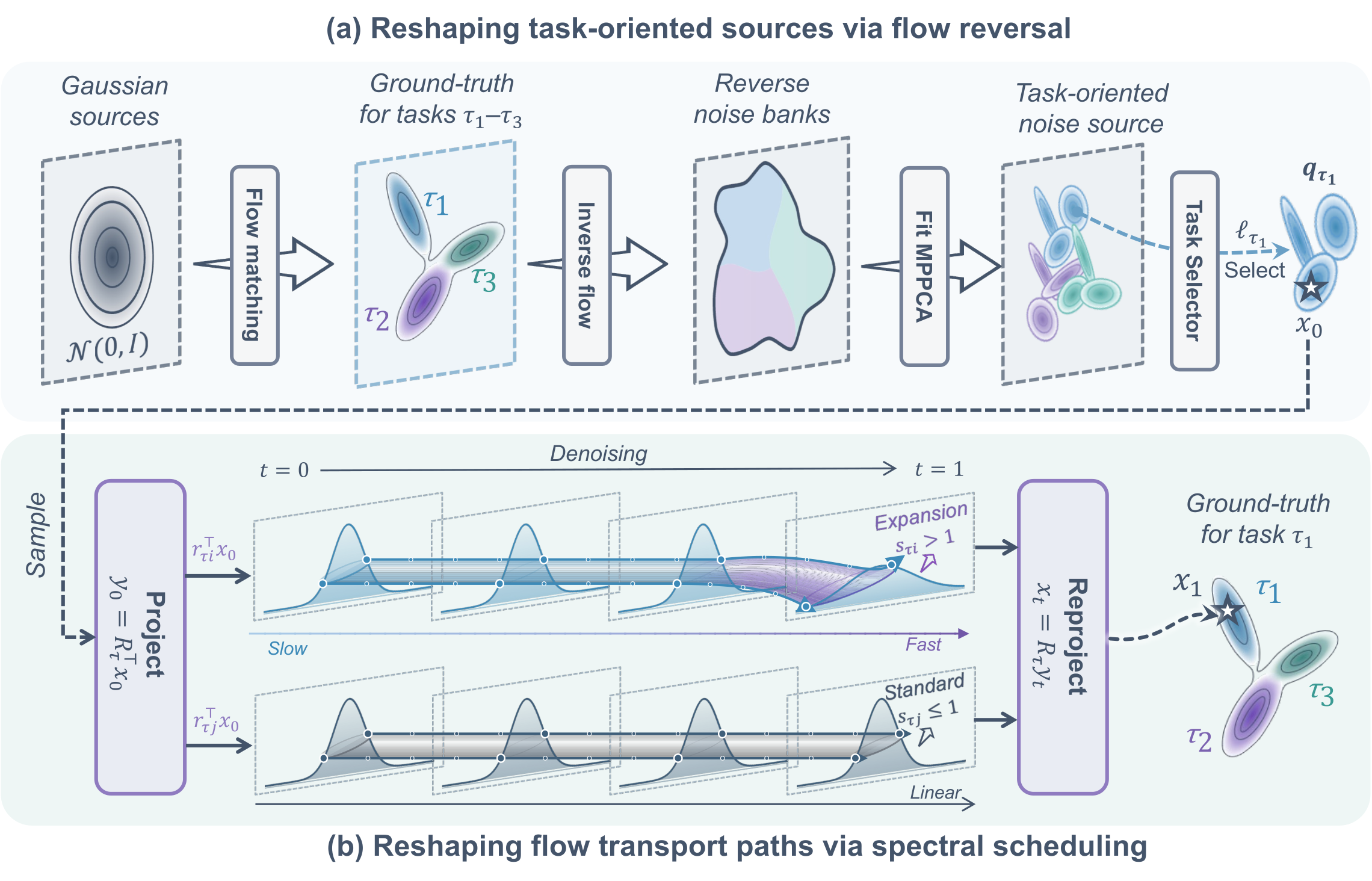
Reverse-mapped expert action chunks are task-structured, with sub-clusters inside each task. TOPS fits a mixture of probabilistic PCA models (MPPCA) to each task's reverse images, and a lightweight language selector picks the source at inference.

02 Slow-then-fast schedules

Move slowly early, fast late — only where expansion is needed

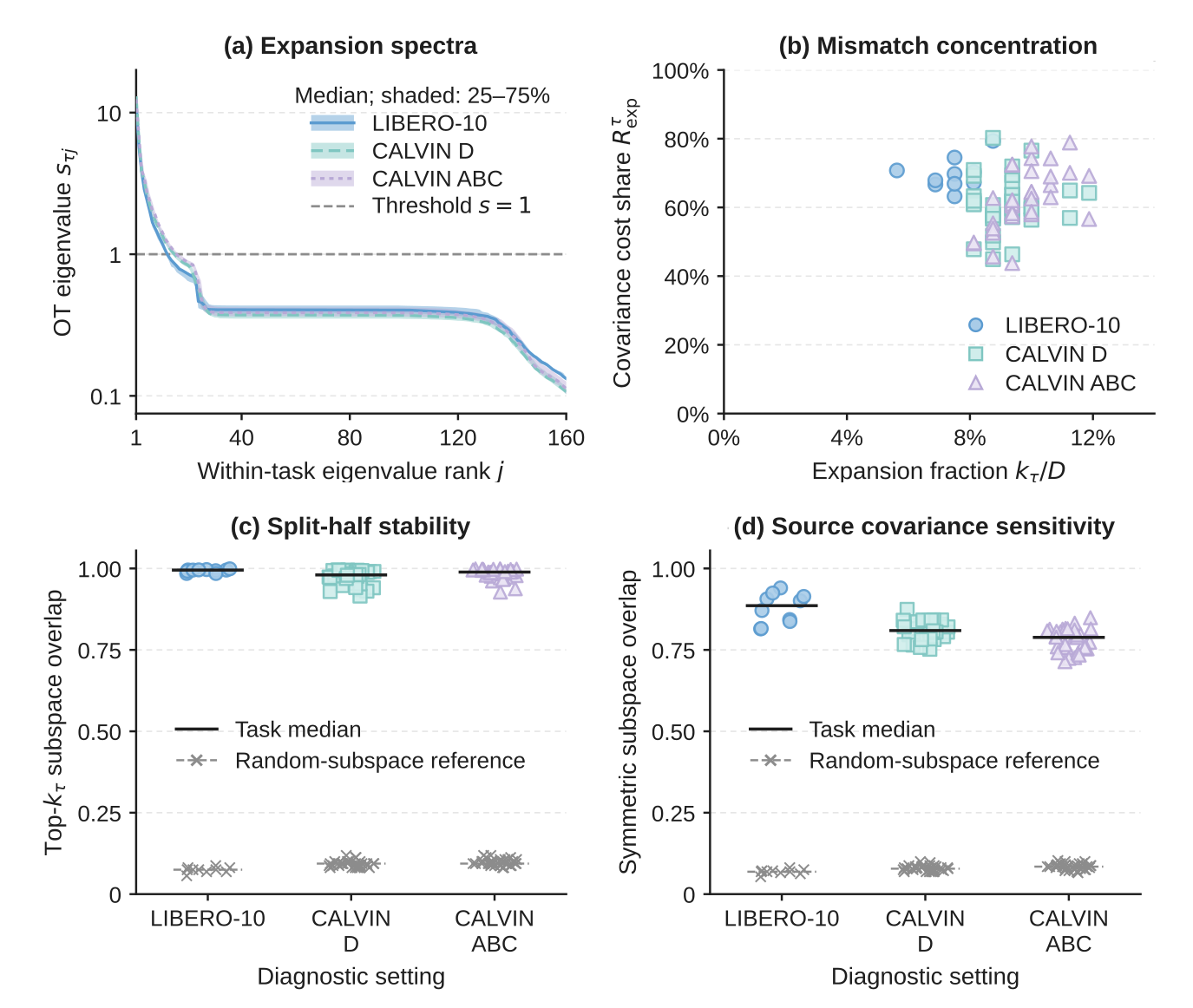
A Gaussian optimal-transport map between source and expert covariances exposes a few expansion directions (7–10% of dimensions, 60–70% of the covariance cost). Along them, TOPS interpolates slow-then-fast; elsewhere it stays linear. A velocity-prediction risk bound motivates the asymmetry.

03 One step, better, faster

Highest mean performance in ID and OOD with NFE = 2

With a schedule-aware integrator, one step beats ten-step baselines on LIBERO-10, LIBERO-Plus, and CALVIN, improves data efficiency, transfers to π0.5, and lifts real-robot success from 51% to 78% pooled over eight tasks.
Motivating analysis

Where do expert actions go when you reverse the flow?

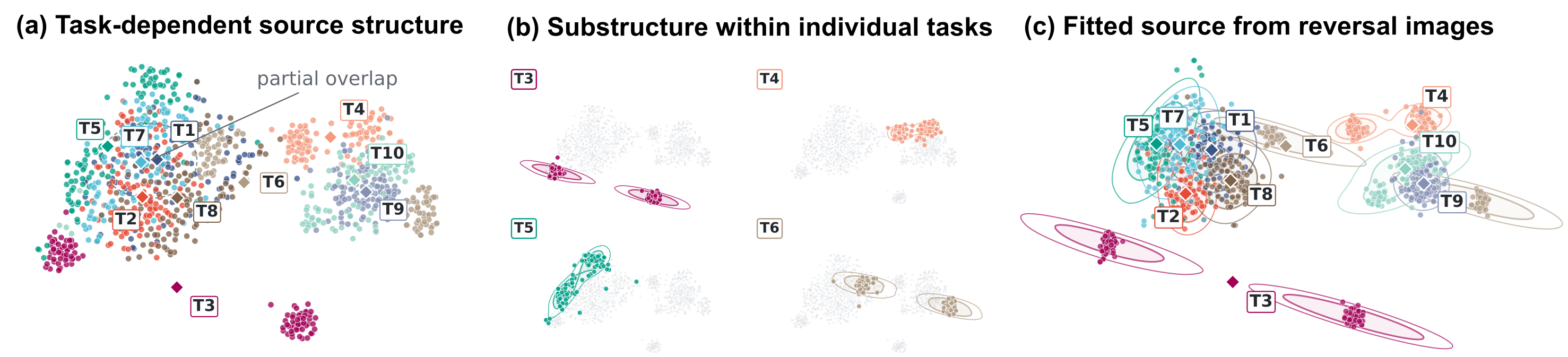
We warm up a standard multi-task flow policy, then integrate it backwards: each expert action chunk is traced to the source sample that would have generated it. The reverse images are not an amorphous Gaussian cloud.

t-SNE of reverse images from the ten LIBERO-10 tasks, the within-task sub-clusters, and the samples from the fitted per-task sources.
Figure 1. Task-structured reverse images and the fitted source on LIBERO-10. (a) t-SNE of reverse images from the ten tasks: tasks occupy distinct, partially overlapping regions. (b) One task highlighted per view, showing sub-clusters within individual tasks. (c) Samples from the fitted per-task sources in the same coordinates reproduce the structure in (a).
①

Task-dependent source structure

Under the warm-up policy, reverse-mapped actions are organised by task and by execution stage (reaching, grasping, placing). Standard FM asks the network to recover all of this from a single task-independent Gaussian.

②

Unequal source-to-target change

Relating source and expert covariances through a Gaussian optimal-transport map, expert actions have substantially larger standard deviation than source samples only along a few axes — the expansion directions. Linear interpolation applies the same timing along every axis regardless.

③

Expansion is small, costly and stable

Across LIBERO-10 and CALVIN, expansion directions occupy only 7.4–9.7% of dimensions but account for 60.9–69.6% of the Gaussian-OT covariance cost; on LIBERO-10 they load 76.9% on the gripper coordinate.

Empirical characterization of expansion directions: sorted OT eigenvalues, expansion fraction versus covariance-cost share, subspace stability, and sensitivity to the source covariance.
Figure 9. Expansion is concentrated and stable. (a) Sorted OT eigenvalues per task; (b) expansion fraction vs. covariance-cost share; (c) top-k subspace overlap across 20 random data splits (0.97–0.99); (d) overlap between fitted-source and isotropic-source expansion subspaces.
Method

Two offline constructions, zero architectural changes.

TOPS reshapes (a) where generation starts — a task-specific multimodal source selected by language — and (b) how it moves — a direction-dependent interpolation schedule in the task's OT eigenbasis. Both are built once from a warm-up policy, then frozen while the velocity field continues training. The animations below are interactive.

A Reshaping task-oriented sources via flow reversal

Conceptual 2-D illustration · auto-plays, click a step to jump

B Reshaping transport paths via spectral scheduling

Exact Gaussian-endpoint computation · drag the slider
Strength ρτj
0.40
End / start speed
2.49×
Risk bound ∫R̄ vs. linear
−12%
Optimum a★ vs. linear
−16%
linear 1−tTOPS (1−t)eρtbound-optimal a★
ρτj = κ·tanh(γ·log sτj)·𝟙{sτj>1} with κ = 0.5, γ = 1 here. For s ≤ 1 the direction is not expanding and TOPS keeps linear interpolation. The optimal schedule a★ minimises the time-integrated Gaussian risk bound and satisfies |ȧ★(1)|/|ȧ★(0)| = s.
Top: an expansion direction (target std = s × source std). The band is the exact distribution of the interpolant yt; thin lines are individual source–expert pairs. Bottom: a non-expanding direction keeps the linear path. The right-hand gauge shows the instantaneous risk bound R̄(t), which TOPS lowers early at the cost of a small increase late.
Overview of TOPS: (a) task-specific sources from MPPCA fitted to reverse-mapped expert actions with an instruction selector; (b) slow-then-fast interpolation along expansion directions in the Gaussian-OT eigenbasis and linear interpolation elsewhere.
Figure 2. Overview of TOPS. (a) We construct task-specific sources by fitting MPPCA models to reverse-mapped expert actions. An instruction selector maps the input language to an index τ̂, identifying the source qτ̂ and its associated schedule. (b) In the selected task's Gaussian-OT eigenbasis, we apply slow-then-fast interpolation along expansion directions and linear interpolation elsewhere, then map the interpolated states and velocity targets back to action space.

Task-specific source (MPPCA)

\[ q_\tau(x_0)=\sum_{m=1}^{M_\tau}\pi_{\tau m}\,\mathcal N\!\big(x_0;\mu_{\tau m},\Sigma_{\tau m}\big),\qquad \Sigma_{\tau m}=U_{\tau m}\Lambda_{\tau m}U_{\tau m}^{\top}+\sigma_{\tau m}^{2}I_D \]

Fitted by EM to each task's bank of reverse images Bτ. The r ≪ D columns of Uτm capture coordinated variation across timesteps and action dimensions; the isotropic residual keeps the source full-rank. Default Mτ = 2, r = 20.

Expansion directions from Gaussian OT

\[ \begin{gathered} T_\tau=(C^s_\tau)^{-1/2}\Big[(C^s_\tau)^{1/2}C^d_\tau(C^s_\tau)^{1/2}\Big]^{1/2}(C^s_\tau)^{-1/2},\qquad T_\tau C^s_\tau T_\tau=C^d_\tau \\ T_\tau=R_\tau\,\mathrm{diag}(s_{\tau 1},\dots,s_{\tau D})\,R_\tau^{\top} \end{gathered} \]

Tτ maps the source covariance onto the expert covariance. Each eigenvalue sτj is the expert-to-source standard-deviation ratio along rτj; directions with sτj > 1 are expansion directions.

Slow-then-fast schedule & risk bound

\[ \begin{gathered} \rho_{\tau j}=\kappa\tanh(\gamma\log s_{\tau j})\,\mathbb 1\{s_{\tau j}>1\},\qquad a_{\tau j}(t)=(1-t)\,e^{\rho_{\tau j}t} \\ \frac{|\dot a^\star_{\tau j}(1)|}{|\dot a^\star_{\tau j}(0)|}=s_{\tau j}\quad\text{for the bound-optimal schedule } a^\star_{\tau j} \end{gathered} \]

Under independent Gaussian endpoints, the Bayes velocity-prediction risk is bounded by a sum of directional terms. Minimising the time integral of the bound yields schedules whose endpoint speeds are in ratio sτj: slower at the source, faster at the expert. The bounded parameterisation above captures 77.5% of the attainable improvement on LIBERO-10 expansion directions.

Path, velocity target, one-step inference

\[ \begin{gathered} x_t=x_1+(1-t)\,e^{-tK_\tau}(x_0-x_1), \\ u_t=e^{-tK_\tau}\big[I_D+(1-t)K_\tau\big](x_1-x_0), \\ K_\tau=R_\tau\,\mathrm{diag}(-\rho_{\tau 1},\dots,-\rho_{\tau D})\,R_\tau^{\top} \end{gathered} \]

The velocity field is trained with the usual FM loss on these targets. At inference a learned MiniLM–MLP selector maps the instruction to τ̂, and a two-stage schedule-aware integrator integrates the known schedule exactly while re-estimating the displacement at the midpoint — one step, two network evaluations.

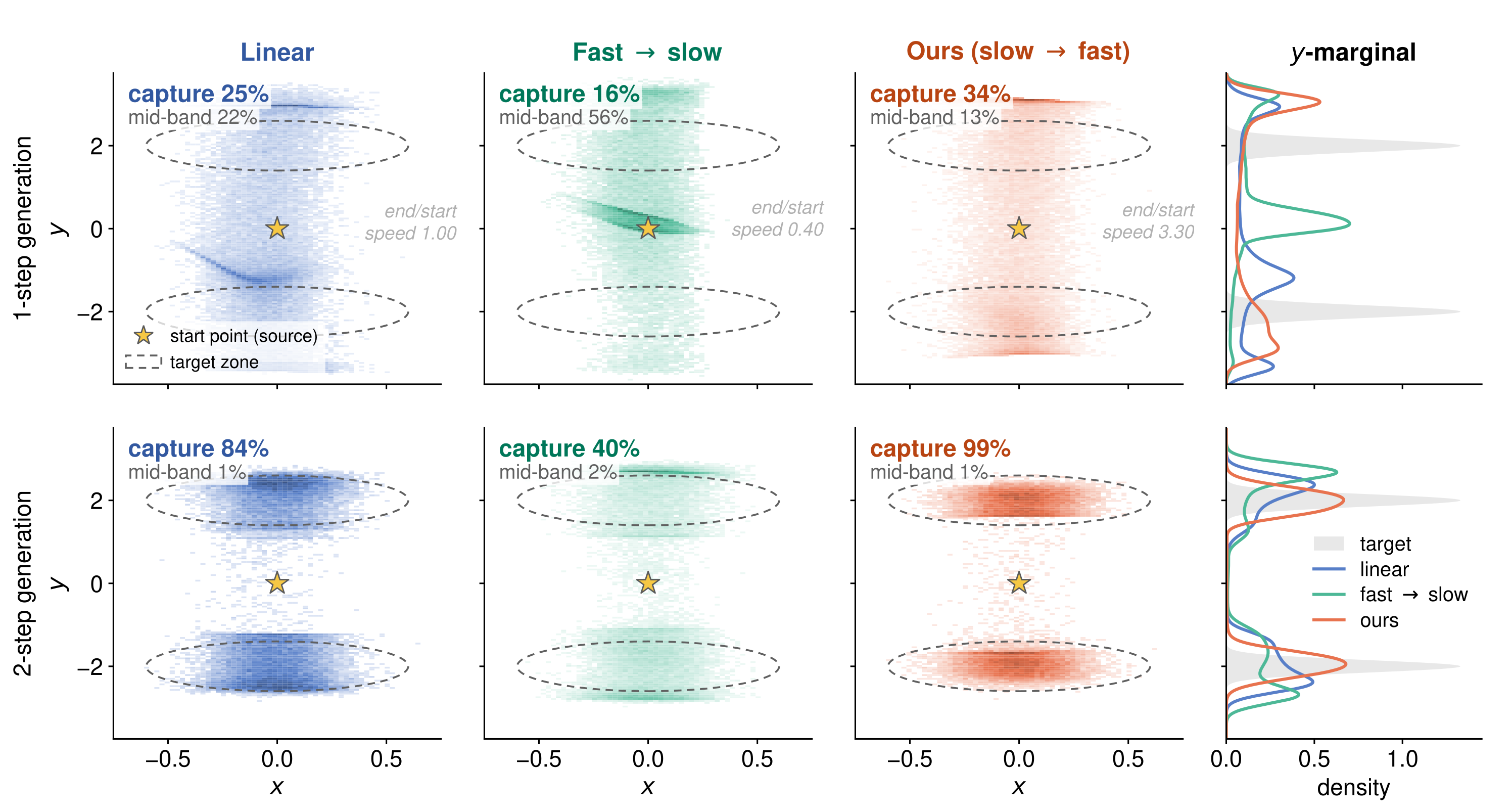
Toy 2-D bimodal generation: linear, fast-then-slow, and slow-then-fast schedules after one and two integration steps, with y-marginals.
Figure 7. Controlled 2-D experiment. Transporting a compact source to two separated modes with a learned velocity field. With two steps, capture reaches 84% (linear), 40% (fast→slow) and 99% (slow→fast, ours). With one step, fast→slow leaves 56% of samples stuck in the mid-band vs. 22% for linear and 13% for ours.

Why the integrator matters

LIBERO-10, one fixed TOPS checkpoint: same trained field, same source — only the solver changes. Generic solvers cannot exploit the non-linear schedule at a budget of two evaluations.

IntegratorNFE = 2NFE = 10NFE = 20
Explicit Euler0.0035.6755.00
Explicit midpoint0.0057.6757.50
Schedule-aware (ours)68.3372.1772.67

Success rate (%), mean over three evaluation seeds. Columns align the number of velocity-network evaluations.

Scheduling alone helps single-task policies too

Robomimic, one policy per task, 200 demonstrations each. Both rows keep the same fixed Gaussian source; only slow-then-fast scheduling and its integrator are added. Cells read Standard FM → TOPS scheduling.

Task1 step5 steps10 steps
Lift100.0 → 100.0100.0 → 100.0100.0 → 100.0
Can90.7 → 95.392.7 → 95.394.0 → 96.0
Square78.7 → 81.380.7 → 86.782.0 → 88.0
Tool Hang31.3 → 43.334.0 → 46.738.7 → 47.3

Success rate (%), mean of three evaluation seeds on the same 50 initial states. One-step TOPS scheduling already beats ten-step Standard FM on Can and Tool Hang.

Simulation results

One step. Highest mean performance, in and out of distribution.

All methods share the same DiT backbone, action representation, horizons, and a 600-epoch budget. LIBERO reports success rate (%); CALVIN reports mean completed chain length out of five. t is the measured per-call latency on an RTX PRO 6000.

LIBEROCALVIN
MethodNFE LIBERO-10 (ID)LIBERO-Plus (OOD)t (ms) D→D (ID)ABC→D (OOD)t (ms)
Standard FM ref.2053.44±2.9327.11±0.3449.41.90±0.050.70±0.0356.2
OT-CFM coupling2030.17±2.7219.02±0.1249.41.28±0.050.46±0.0258.9
2-ReFlow few-step237.17±3.1220.22±0.357.11.74±0.050.66±0.038.6
RF-distill few-step129.17±0.9417.56±0.064.81.75±0.050.70±0.035.8
MeanFlow few-step159.00±2.8334.73±0.325.71.89±0.020.86±0.025.4
PriorGrad source2062.33±0.2430.56±0.3048.31.97±0.061.02±0.0455.4
MM-FM source2034.67±3.1716.75±0.4948.81.75±0.050.68±0.0352.5
LeaP source2060.25±3.8930.72±0.8349.61.74±0.020.73±0.0358.7
Regression none140.17±0.6222.17±0.505.10.88±0.030.27±0.025.7
Source only (fixed Mτ) ours259.17±0.3635.21±0.667.62.12±0.060.88±0.048.8
Source only (task-wise Mτ) ours263.17±0.6430.52±0.667.62.15±0.060.98±0.048.6
TOPS (ours) ours269.67±0.6135.29±0.088.22.27±0.061.05±0.049.0

Table 1. Mean ± sample s.d. across three independent training runs. LIBERO-Plus means cover 2,100 variants across six perturbation categories (Camera excluded, all methods score zero). CALVIN averages over 1,000 five-task chains. Bold = best, underlined = second best per column. TOPS uses one two-stage schedule-aware step; ten-step baselines use explicit midpoint (NFE = 20).

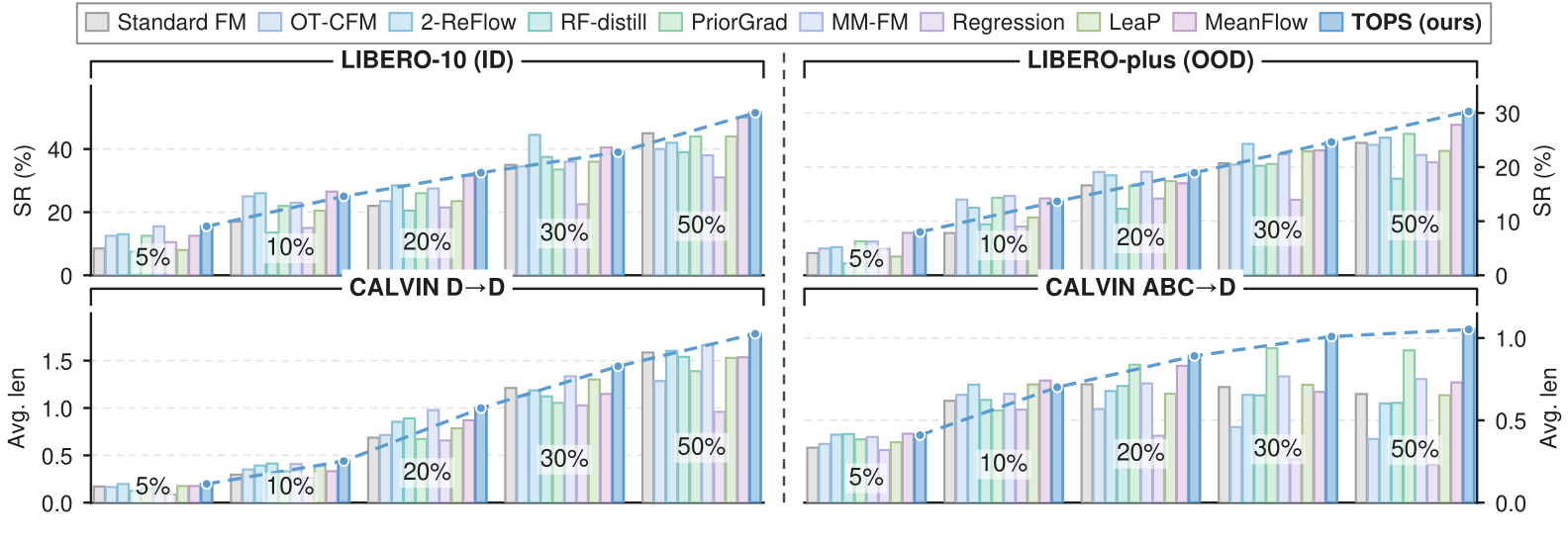
Data efficiency: performance with 5 to 50 percent of the demonstrations on four benchmarks.
Figure 3. Data efficiency. With 5%–50% of the demonstrations, TOPS outperforms Standard FM in all 20 benchmark–budget configurations and matches or exceeds the strongest baseline in 14. On CALVIN ABC→D, TOPS trained on 30% of the data beats every baseline trained on 50%.
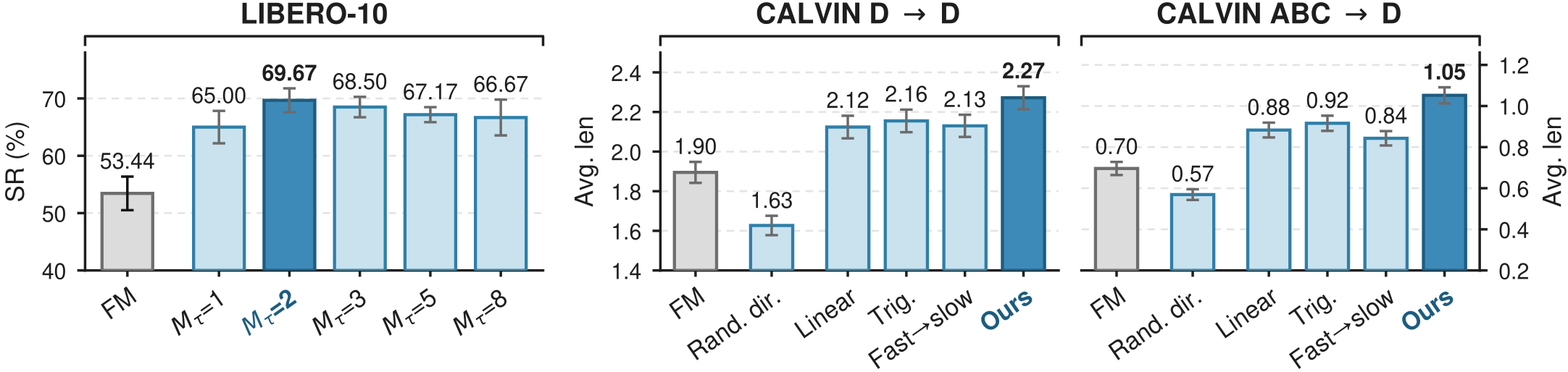
Ablations: LIBERO-10 success versus mixture count, and CALVIN path ablations with random directions, trigonometric interpolation, and fast-then-slow timing.
Figure 6. Ablations. Left: every mixture count Mτ ∈ {1,2,3,5,8} beats Standard FM; Mτ = 2–3 is best. Middle/right: with the source fixed, random directions hurt badly, while trigonometric and fast→slow timing fall short of slow→fast on both CALVIN splits.
Transfer to a large-scale VLA

Same recipe on π0.5: better in all four settings.

Starting from the official pi05_base checkpoint with the standard LoRA recipe and a shared 14K-step budget, TOPS resumes from an intermediate baseline checkpoint and changes only the source, transport target, and sampler. Baseline: ten Euler steps. TOPS: one schedule-aware step (NFE = 2).

LIBERO-10 · ID
94.8%+0.8
π0.5
94.0
π0.5 + TOPS
94.8
success rate (%)
LIBERO-Plus · OOD
69.0%+4.6
π0.5
64.4
π0.5 + TOPS
69.0
success rate (%) · lighting 77.5→94.2, object layout 74.1→84.3
CALVIN D→D · ID
3.941+0.268
π0.5
3.673
π0.5 + TOPS
3.941
avg. completed chain length (of 5)
CALVIN ABC→D · OOD
3.744+0.711
π0.5
3.033
π0.5 + TOPS
3.744
avg. chain length · five-task completion 41.2% → 61.1%
Real-world experiments

Eight tasks, three suites, one Galaxea R1 Lite.

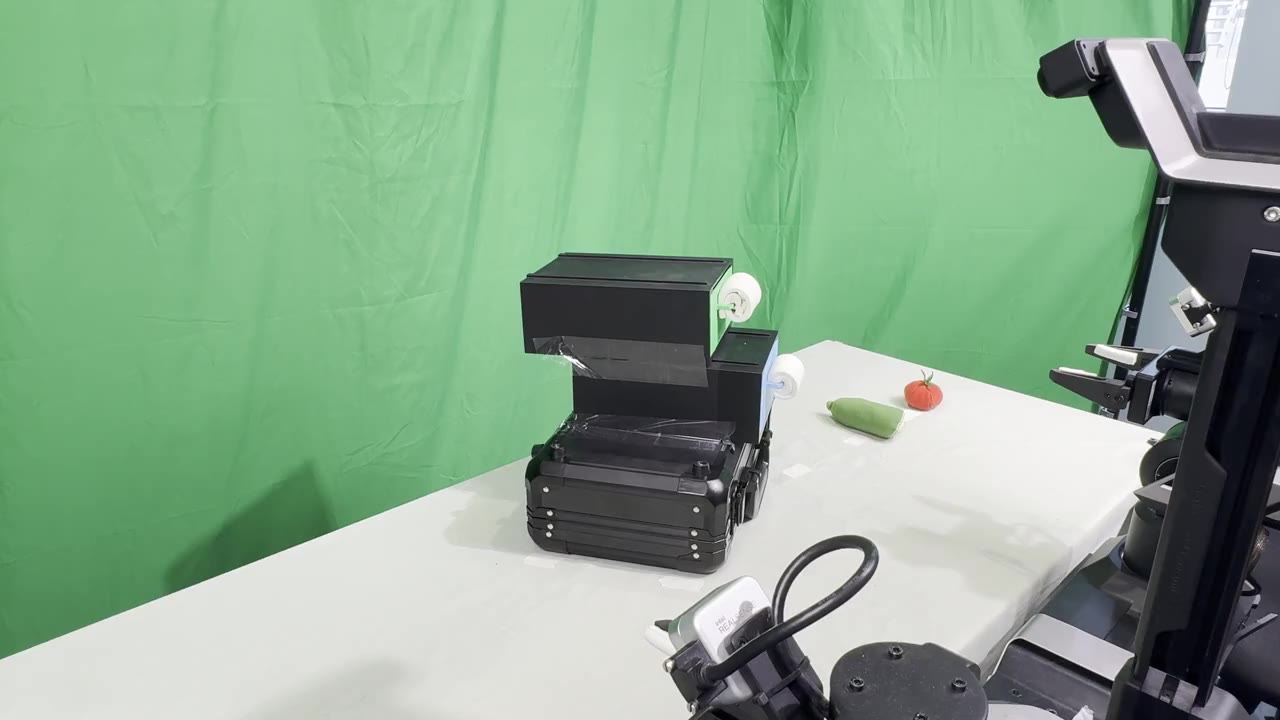
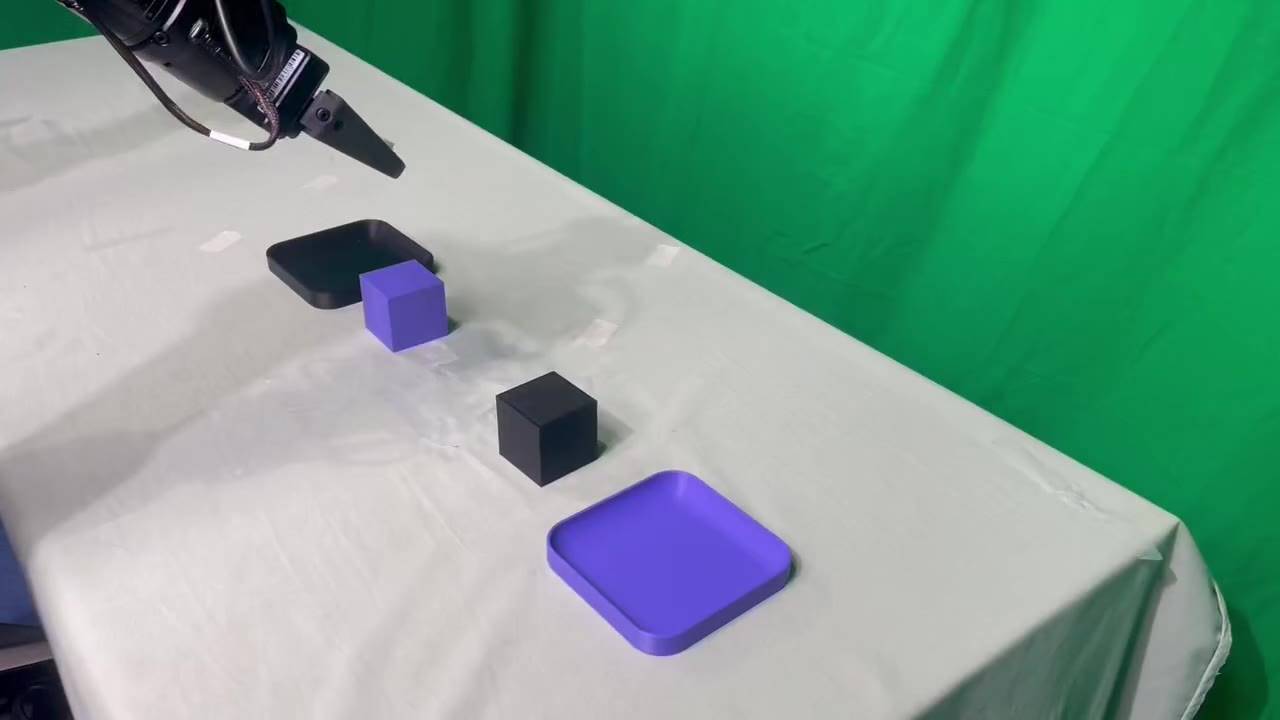
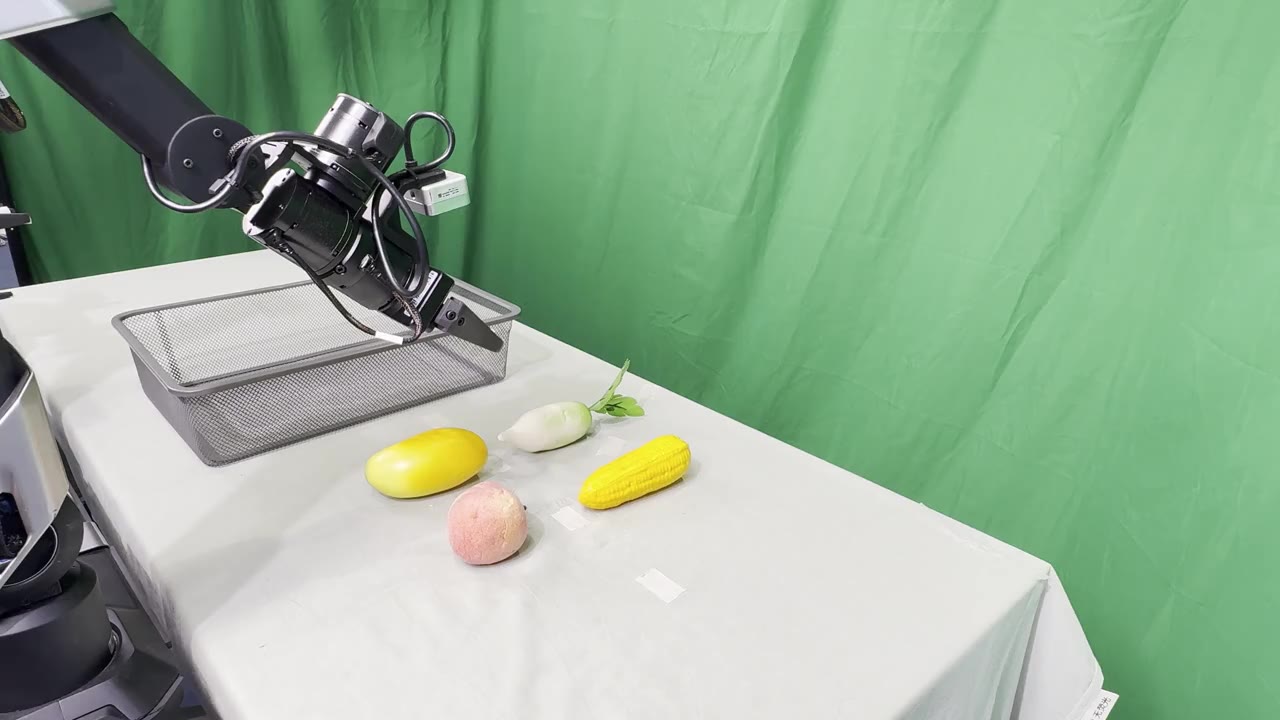
Policies receive head- and wrist-camera RGB, proprioception, and a language instruction. Within each suite all candidate targets are present in a shared scene, so the instruction is the only signal that identifies the task. 20 rollouts per task, 160 per method.

Drawer Opening scene
Drawer Openingupper or lower drawer · 50 demos per task
Color Matching scene
Color Matchingpurple or black cube → matching tray · 50 demos per task
Pick-Vegetable scene
Pick-Vegetabledaikon, corn, mango or peach → box · 30 demos per task

Per-task success rate (%) · 20 rollouts each

Standard FMPriorGradTOPS (ours)
124 / 160
TOPS successes pooled over the eight tasks (77.5%), vs. 82 / 160 (51.25%) for Standard FM
+26.25 pts
two-sided two-proportion z-test: z = 4.90, p < 0.001
6 / 8
tasks where TOPS is strictly best; ties at 100% on daikon and corn
Rollout videos

TOPS vs. baselines, side by side.

Same scene, same instruction, same checkpoint budget. Pick a suite and a task; the three policies play side by side.

Citation

BibTeX

@article{an2026tops,
  title   = {TOPS: Reshaping Flow Source and Transport for Multi-Task Robot Manipulation},
  author  = {An, Tuo and Zhou, Chuhao and Dong, Jiahua and Li, Jingliang and
             Bai, Jiaqi and Jia, Jindou and Yang, Jianfei},
  journal = {arXiv preprint arXiv:2610.36694},
  year    = {2026}
}

Limitations. TOPS incurs an offline cost to construct task-specific sources and schedules, which remain fixed during subsequent training and deployment. It selects among predefined tasks and uses a fixed action-chunk length; generalisation to unseen task identities is outside our evaluation.

Copied to clipboard