ODE Policy

Robot learning via action dynamics, not actions

Jindou Jia*‡, Jingliang Li*, Kuangji Zuo*, Tuo An*, Yuxuan Hu, Mengfei Zhao, Bofan Lyu, Jiaqi Bai, Daoyuan Zhu, Hengyu Dai, Junpeng Zhang, Jianfei Yang†
MARS Lab, Nanyang Technological University
* Equal contribution  ·  ‡ Project lead  ·  † Corresponding author

Autonomous · 1–4× Scroll

Natura non facit saltus.

Nature does not make jumps.  — G. W. Leibniz, 1704

Video

ODE policy in 90 seconds

§ 01 — Idea

Actions should not jump either

A direct-action policy predicts each chunk of actions on its own, so the motion jumps where chunks meet. ODE policy learns how the action changes and integrates it over the robot's physical time, so each action follows from the previous one.

Direct-action policy jumps at chunk boundaries
ODE policy continuous by construction

§ 02 — Results

Results

5.9×
success after one epoch
10.8×
faster inference
5.4×
zero-shot success under unseen perturbations
14/14
real-robot tasks with the highest success
3.9×
mode balance after one epoch

Ratios against flow matching in imitation learning. Hover over any chart for its numbers.

01Learns fast

As a visuomotor policy, as the action head of a VLA and a world action model, and as the actor in RL, ODE policy learns faster than direct-action policies.

Imitation learning on LIBERO

Figure 1. Success rate over training, four suites trained jointly, mean and std over three random seeds. ODE policy reaches 79.2% after one epoch and 85% after two, where A2A-DiT needs four, the flow and diffusion baselines thirty or more, and ACT never gets there.

Gain over FM-DiT, less data and smaller models

Figure 2. Gain of ODE policy over FM-DiT in success rate (percentage points), by training epoch and by demonstrations per task or parameters, mean over three random seeds. The gain is positive in every cell and largest early in training, up to 65.7 points after one epoch.

Action head of a VLA (π0.5)

Figure 3. A randomly initialized ODE head with 3% of the parameters of the flow matching expert. It leads the pretrained expert early and stays close afterwards. One seed, band over the four suites.

Action head of a world action model (ImageWAM)

Figure 4. ODE head against the original flow matching head and an A2A head, 82.6% against 24.6% after one epoch. One seed, band over the four suites.

Actor of SuperMimic in reinforcement learning

ODE actor

Gain in training return

Gain in evaluation return
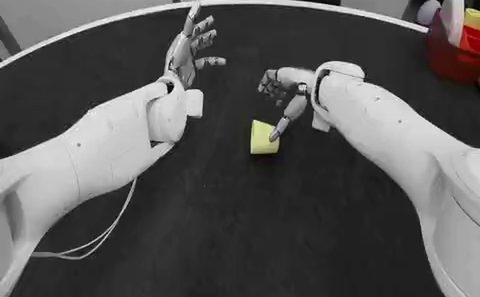
Figure 5. Gain of the ODE actor over the direct-action actor of SuperMimic, which learns through a world model, on whole-body tracking of 40 LAFAN1 clips with a simulated G1 humanoid, from the means over three random seeds, over wall-clock hours on one GPU. Replacing only the actor raises the training return by 37% after 0.75 hours and the return on all clips by 30% after 0.4 hours and still 5% after 2.9 hours.

02Succeeds on real robots

Tasks on four robots, from precise insertion to bimanual and walking manipulation. ODE policy has the highest success rate on all fourteen real-robot tasks, including the three cross-lab tasks under Generalizes. Each card compares it with the best baseline over 20 trials.

Single-arm robot

Franka Research 3, 40 demonstrations per task, 50 epochs

Box packing

Put a mango into a box and close the lid.

ODE 95%
A2A-DiT 75%

Key hanging

Grasp a key and hang it on a hook.

ODE 90%
A2A-DiT 75%

Sock folding

Fold a sock, put it into a drawer, close the drawer.

ODE 75%
FM-DiT 40%

Block insertion

Insert a block into a matching hole.

ODE 70%
FM-DiT 20%

Dual-arm robot

Galaxea R1 Lite, joint actions, 300 epochs

Flower insertion

Insert a thin stem into a narrow opening.

Poppy
ODE 30%
FM-DiT 20%
Dahlia
ODE 60%
FM-DiT 40%

Bimanual microwave

Bowl into the microwave, push it in, close the door. 34 demonstrations.

ODE 75%
FM-DiT 20%

Two flowers

Insert two flowers one after the other, at least one inserted.

ODE 55%
FM-DiT 20%

Drawer, either arm

One arm puts an apple into the drawer, the other closes it. Both modes used.

ODE 60%
FM-DiT 0%

Dexterous hand

Sharpa North

Can to plate

Pick up a can and place it on a plate. 50 demonstrations.

ODE 90%
FM-DiT 70%

Humanoid

Unitree G1, action head of GR00T N1.7, 90 demonstrations per task

Toy to sofa

Walk to a toy, squat to grasp it, and put it into a box on the sofa.

ODE 60%
GR00T 35%

Humanoid microwave

Grasp a rice ball, walk to the microwave, put it inside, close the door.

ODE 70%
GR00T 30%

03Executes precisely and smoothly

Where flow matching and diffusion policies fail, ODE policy finishes the task. Click a baseline to see how it fails.

ODE policy3×

Bimanual microwave

Grasp a bowl, place it in the microwave, push it in, close the door with the other arm.

75% ODE  ·  20% FM-DiT  ·  0% DDPM  ·  0% DDIM

Click a baseline to play it in the large view.

ODE policy2×

Flower into a narrow vase

Insert a thin stem into a small opening, which leaves almost no room for error.

30% / 60% ODE  ·  20% / 40% FM-DiT  ·  0% / 0% DDPM  ·  0% / 5% DDIM (poppy / dahlia)

Click a baseline to play it in the large view.

Inference and smoothness on the real robots

Figure 6. One task per robot, box packing, the bimanual microwave, and can to plate, mean and std over episodes, with the human demonstrations as the dashed line. ODE policy generates a chunk 3.5 to 27× faster than the diffusion and flow matching baselines, and its measured motion is as smooth as the demonstrations or smoother, while the baselines reach up to 12× their jerk.

Speed and success on LIBERO

Figure 7. Time per chunk of 8 actions against success at epoch 100. ODE policy takes 5.7 ms with Euler, 10.8× faster than FM-DiT, and keeps its success with every solver.

At scale, in π0.5

Figure 8. The ODE head generates a chunk in 2.2 ms instead of 31.8 ms, so the whole model runs in 42.4 ms instead of 66.6 ms, and the command changes half as much across chunk boundaries.

04Generalizes

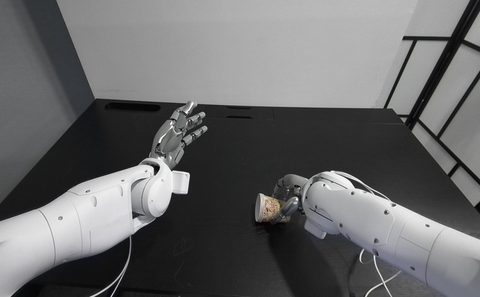
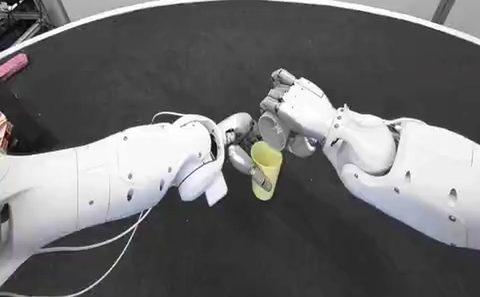
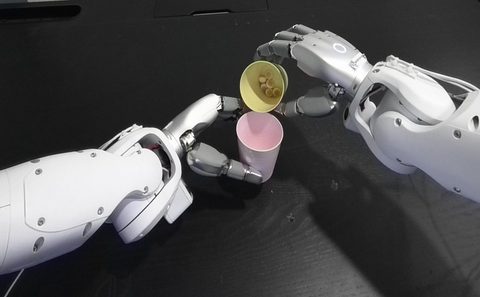
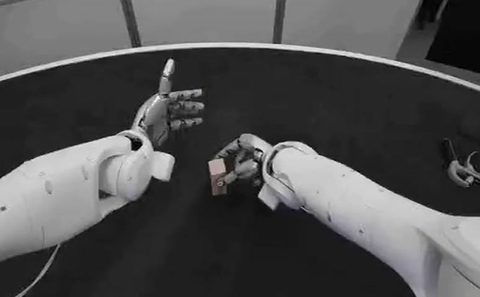
On real dexterous hands, ODE policy transfers skills learned only from public demonstrations of another lab (SharpaDex) to our lab, with other objects and backgrounds and without any demonstration from our setup.

Cup reorientation

Set a fallen cup upright, with other cups and another background.

Cup reorientation, training data from SharpaDexSharpaDex data
Cup reorientation, deployment in our labOur lab
ODE 85%
FM-DiT 0%

Pill pouring

Pour pills between two cups with two hands, with cups of other colors.

Pill pouring, training data from SharpaDexSharpaDex data
Pill pouring, deployment in our labOur lab
ODE 85%
FM-DiT 50%

Cube stacking

Stack a red cube on a green one, where the demonstrations use wooden cubes.

Cube stacking, training data from SharpaDexSharpaDex data
Cube stacking, deployment in our labOur lab
ODE 65%
FM-DiT 0%

In simulation, zero-shot on LIBERO-plus, with unseen camera views, initial states, layouts, backgrounds, lighting, and sensor noise.

Visuomotor policies

Figure 9. Robust early, 30.1% after one epoch against at most 22.6%. Three random seeds.

VLA (π0.5)

Figure 10. Without pretraining and with 3% of the parameters, ahead of the randomly initialized expert throughout.

WAM (ImageWAM)

Figure 11. 89.9% at epoch 10, ahead of both heads throughout.

05Keeps multi-modality

A sampled direction tilts the field toward one mode, so ODE policy keeps distinct behaviors. On the real robot, either arm may put the apple into the drawer while the other closes it, and ODE policy uses both.

Left arm places2×
Right arm places2×
FM-DiT2×left arm misses the apple
FM-DiT2×right arm misses the apple

Learned from 25 demonstrations per mode. Over 20 trials, ODE policy places the apple with the left arm 8 times and with the right arm 12 times, with 5/8 and 7/12 successes (60%). FM-DiT goes for the apple with both arms (14 and 6 times) but succeeds in none.

Rollouts of ODE policy

Figure 12. An agent passes one of four gaps to reach the goal. Each rollout samples a direction once and follows one route. Illustration.

Task success

Figure 13. Success over training, mean and std over three random seeds.

Mode balance

Figure 14. γ is 1 if the four routes are taken equally often and 0 if some route is never taken. After one epoch, 0.54 against 0.14 for FM-DiT.

§ 03 — Method

Method

ODE policy replaces only the action head. The encoder, the data, and the training schedule stay the same.

1Learn a velocity, not an action

The images and the instruction are encoded into an embedding $\mathbf z_t$, as in any policy. The network $\mathbf f_\theta$ outputs how the action should change, given the action $\mathbf a(t)$ the robot is commanded to reach and its proprioception $\mathbf s_t$. Time $t$ is the physical time of the robot.

Because the field sees the current action, each step depends on where the motion has arrived. A direct-action policy outputs a whole chunk at once and cannot react to its own intermediate actions.

$$\dot{\mathbf a}(t)=\mathbf f_\theta\big(\mathbf a(t),\,\mathbf s_t,\,\mathbf z_t\big)$$

2Integrate chunk by chunk

Every $H=8$ steps, the policy reads the observation once and holds $\mathbf z_t$ and $\mathbf s_t$ fixed. It then integrates the field with RK4, one action after another, and the next chunk starts from the last integrated action. This gives three benefits.

$$\hat{\mathbf a}_{t+k+1}=\hat{\mathbf a}_{t+k}+\int_{t+k}^{t+k+1}\mathbf f_\theta\big(\mathbf a(t'),\mathbf s_t,\mathbf z_t\big)\,\mathrm dt'$$

Smooth

Chunks join without jumps. The motion is one integral curve whose condition is refreshed every 8 steps.

Streaming

Each action is sent as soon as it is integrated. A chunk takes 5.7 ms with Euler, against 61 ms for FM-DiT.

Any control rate

The field lives in continuous time, so one model runs at a finer rate by integrating with a smaller step.

3Train by matching the path

Start from a demonstrated action, integrate $H$ steps, and match the whole path. The gradient flows back through the solver, and no velocity labels are needed.

Contractive perturbation. Some segments start from a shifted point $\mathbf a_t+\boldsymbol\delta$, and the target shrinks the shift by $\rho^k$ at step $k$. The field learns to pull drift back, at no cost at inference.

$$\mathcal L_{\text{path}}^{\boldsymbol\delta}=\frac1H\sum_{k=1}^{H}\big\|\hat{\mathbf a}_{t+k}(\mathbf a_t+\boldsymbol\delta)-(\mathbf a_{t+k}+\rho^{k}\boldsymbol\delta)\big\|_2^2$$

During training

Orange segments are the errors between the integrated steps and their targets. Training removes them.

After training

Paths from perturbed starts return to the demonstration.

4Optional diversity head

A deterministic field averages distinct behaviors, e.g., passing an obstacle on the left or on the right, and heads into the obstacle. A small head reads the features of the field once per chunk and samples a direction $\boldsymbol\epsilon$ with a rate $\boldsymbol\lambda_k$ per step, which tilts the field toward one route. It is trained on detached inputs, so the gradient of $\mathbf f_\theta$ stays unchanged.

$$\dot{\mathbf a}(t')=\mathbf f_\theta\big(\mathbf a(t'),\mathbf s_t,\mathbf z_t\big)+\boldsymbol\lambda_k\odot\boldsymbol\epsilon$$

5The same field as an RL actor

In RL, the field acts at every control step ($H=1$) and takes one Euler step from the previous action. Only the actor is replaced, and the RL algorithm trains the field through this step. In SuperMimic, which backpropagates the return through 32 imagined steps of a world model, the identity in $\partial\hat{\mathbf a}_t/\partial\hat{\mathbf a}_{t-1}$ carries the gradient to early actions without decay.

$$\hat{\mathbf a}_t=\hat{\mathbf a}_{t-1}+\mathbf f_\theta\big(\hat{\mathbf a}_{t-1},\mathbf s_t,\mathbf z_t\big)$$

§ 04 — Cite

BibTeX

@article{jia2026ode,
  title   = {{ODE} Policy: Robot Learning via Action Dynamics, Not Actions},
  author  = {Jia, Jindou and Li, Jingliang and Zuo, Kuangji and An, Tuo and Hu, Yuxuan and Zhao, Mengfei
             and Lyu, Bofan and Bai, Jiaqi and Zhu, Daoyuan and Dai, Hengyu and Zhang, Junpeng and Yang, Jianfei},
  journal = {arXiv preprint arXiv:2611.01729},
  year    = {2026}
}